
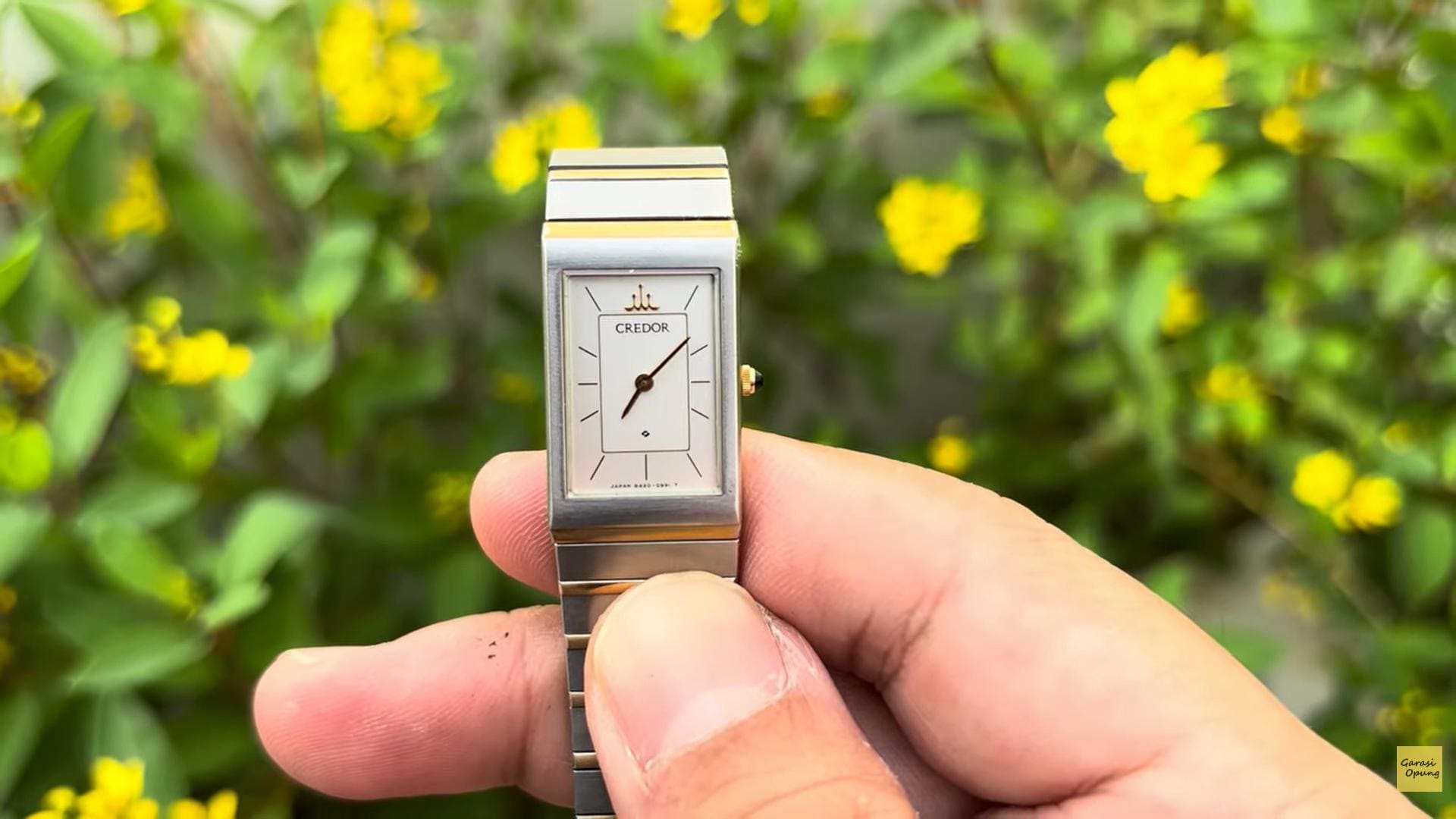
The Seiko Credor 8420-6410 is a slim, tank-style dress watch from the early 1980s that captures Seiko at a moment when the brand treated even its most modest quartz pieces with almost old-world seriousness. It is a watch that hides its sophistication under a thin layer of 22‑karat gold plate and an almost impossibly discreet case profile.
Credor was conceived as Seiko’s high-art answer to the Swiss dress watch, a line that sat apart from the workhorse Seikos on the high street. In the 1980s, when the quartz revolution had already toppled much of the old mechanical order, Credor pursued a different question: what happens when Japanese precision meets the European idea of the elegant, gold dress watch. The 8420-6410 belongs squarely to that era, carrying the seriousness of a luxury product in a format that feels almost fragile by today’s standards.This is a watch from January 1984, when a thin, rectangular case and an integrated bracelet were the language of success from Tokyo to Geneva. It was never meant to shout; it was meant to slip under a cuff and speak only to the person wearing it.
Case, gold, and proportions
The first surprise is the case thickness: around 4 mm, a figure that belongs more to a piece of jewellery than to something housing a complete movement. The case is 22K solid gold plated to a thickness of roughly 20 microns, a more generous layer than the flash plating seen on fashion watches, and one that gives the metal a warmer, richer hue. On the wrist, that high-carat tone is immediately apparent; it has the soft glow of aged gold rather than the shrill brightness of cheaper plating.
Measured across, the watch is often listed at about 16–18 mm, depending on whether sellers take the case or the integrated shoulders as reference. These are unapologetically small numbers, especially next to contemporary sports watches, yet the rectangular “tank” geometry and full metal bracelet grant the piece more presence than the dimensions suggest. This is a watch that reads as a line of gold on the wrist—quiet, flat, and almost architectural.
Dial, bracelet, and the jewellery effect
What makes the 8420-6410 compelling is the way the case, dial, and bracelet resolve into a single object. The integrated bracelet flows directly from the case without visual interruption, so that the watch feels less like a dial with lugs attached and more like a continuous ribbon of metal that happens to tell the time. On a small wrist, that continuity creates a jewellery-like effect; on a larger wrist, it reads as a restrained vintage accent rather than a shrunken men’s watch.
The dial in this family of references tends to be a model of restraint: a clean, light field—often silver or champagne—with simple baton markers and a discreet Credor signature at twelve. There is nearly always more negative space than printing, and that emptiness is the point; it lets the rectangular outline and the glint of the hands do the visual work. In certain lights the dial almost recedes, leaving the polished bezel and bracelet to frame what becomes a small, floating rectangle of tone.
The bracelet itself is typical of early‑1980s Japanese dress design: fine, tight links that drape easily over the wrist and catch light in short, sharp flashes. Because the gold plating extends across case and bracelet, there is a coherence to the ageing; with time, the high points soften and the whole watch takes on the patina of a well‑loved piece of jewellery.
Movement and philosophy
Inside the 8420-6410 beats Seiko’s 8420 quartz calibre, a slim, no‑nonsense movement designed to be both accurate and unobtrusive. It does not have the headline‑grabbing precision of later high‑accuracy quartz calibres like the 4J81, but it reflects the same mindset: if the watch is meant to disappear visually, the movement’s job is to disappear functionally—no drama, no fuss, just quiet, dependable timekeeping.
It is worth remembering that, in 1984, quartz was not the budget option; it was the advanced option, and Credor treated it that way. The point was not to advertise technology on the dial, but to use it in service of a traditional aesthetic: a thin gold watch, worn because it felt right with a pressed shirt and a quiet room.
Wearing and collecting the 8420-6410
To wear the 8420-6410 today is to accept a certain kind of time travel. The dimensions demand a recalibration of expectations; after years of 40 mm sports watches, this little Credor comes across as almost shockingly modest. Yet that modesty is where its strength lies. It does not try to span every context. It is, plainly, a dress watch: best with a cuff, happiest in the evening, entirely comfortable being overlooked by everyone except the person who chose it.
From a collecting perspective, the reference sits in an interesting niche. It carries the Credor name, 22K gold plating, and that wonderfully slim profile, yet it remains relatively accessible on the secondary market compared to later mechanical Credors or Grand Seikos. Much of that is due to its size and the fact that it is a ladies’ or unisex model by period marketing, which keeps prices in check even as interest in Japanese high‑end quartz quietly increases.
Condition, of course, is everything with a watch like this. The 20‑micron gold plating is generous but not infinite, so sharp edges and uniform colour are signs of a well‑preserved example rather than one that has been polished into oblivion. A clean dial, tight bracelet, and a recently serviced or freshly battery‑powered movement round out the package, turning what might seem like a delicate relic into a reliable, wearable link to Seiko’s more refined quartz period.
Seen in this light, the Seiko Credor 8420-6410 is more than a small gold‑plated rectangle from the 1980s. It is an artefact from a moment when Japanese watchmaking took the language of European dress watches and translated it into something quieter, slimmer, and in many ways more honest—luxury that chooses understatement over spectacle, and lets the wearer enjoy the secret.